
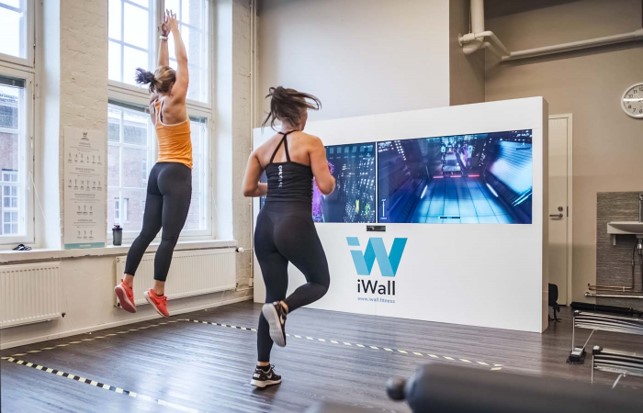
Enhancing the quality of time spent at the airport is a key priority for SEA. With this goal in mind, the company is introducing iWall, a new interactive entertainment solution designed to make the passenger journey more engaging, enjoyable and memorable.
Based on motion-sensor technology, iWall allows passengers to play simply by moving their body, without the need for controllers or additional devices. The experience is immediate and intuitive: users stand in front of the screen and begin interacting with the digital content on display.
Designed to be simple, intuitive and accessible to people of all ages and abilities, iWall offers a range of interactive games, from more dynamic challenges to calmer, more relaxed experiences.
Want to try iWall?
Passengers can experience iWall at Milan Linate and Milan Malpensa airports:
- at Malpensa, in the passport control area of the North satellite
- at Linate, in the A01-A02 gate area
Choose your game and let yourself be drawn into the experience.
The application of AI helps colleagues in the process of compiling the “Giornale di Scalo”.

"Giornale di Scalo" (Airport Log) is an essential tool in airports for keeping track of information related to the movements of aircraft, passengers, and cargo. This tool provides a comprehensive overview of airport operations, allowing for informed decision-making, resource coordination, ensuring safety and operational efficiency, and allocating costs among airlines.
However, compiling the Airport Log is not an easy task: SEA handles over 4,000 messages per day exchanged with airlines and airport operators. Today, this flow of information requires heavy manual management because the received messages extensively use free text, do not always comply with international coding standards, are sent in multiple copies often with inconsistent data, do not contain common keys and unique time references, or arrive asynchronously.
SEA was therefore looking for a solution that could help operators, currently engaged in non-value-added activities such as manually checking the correctness and completeness of the received data.
Thanks to the collaboration with Cefriel and MADE, an artificial intelligence model has been developed, trained on a dataset of over 8 million messages exchanged between hundreds of airlines and airports, capable of accurately predicting the reliability of the information contained in these messages. The model's output can be used to optimize decision-making processes and operations. The achieved performance allows for an estimated maximum efficiency improvement of 30% in manual processing, along with other positive impacts on IT management costs, error rates, and work quality.
INVOLVED DEPARTMENTS: Corporate and Business Communication, Information and Communication Technology, Innovation, Operations, Planning and Control, Supply Chain.
A new system to make check-in even simpler, faster, and more autonomous
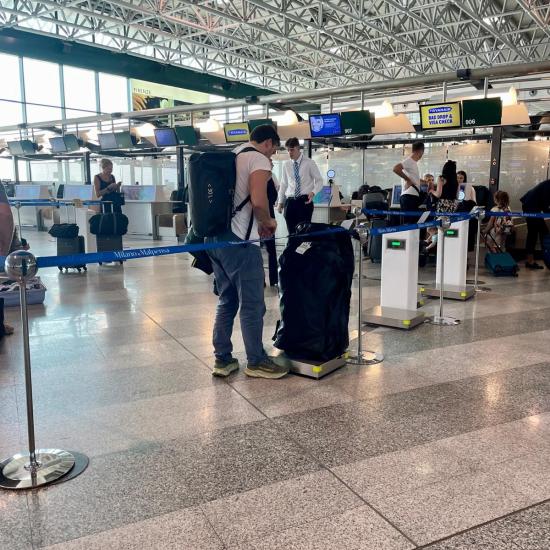
SEA has inaugurated a Self Bag Drop (SBD) system at Malpensa’s Terminal 1, designed to enhance passenger experience and optimize airport operations. The project was developed in collaboration with Arcdata and will be tested for 12 months with Ryanair.
Six tagging stations and three dedicated baggage drop-off counters have been installed at check-in Island 9. Passengers can now weigh their luggage independently, print their tag using the airline's app, and complete the drop-off process without the need to go through an assisted counter.
This solution, already implemented in other international airports, represents a significant step toward increased passenger autonomy and digitalization, reducing waiting times and improving flow efficiency in the check in area. The system was designed to integrate seamlessly with existing infrastructure while ensuring maximum security.
SEA goal is to assess, through this Proof of Concept, passenger satisfaction levels and the operational impact of the new system, with the prospect of extending the service to other airport areas in the future.
INVOLVED DEPARTMENTS: Health & Safety at Work, Information and Communication Technology, Infrastructures Development, Innovation, Maintenance, Operations MXP, Planning and Control, Supply Chain
Receive real-time notifications on your flight status without downloading any app
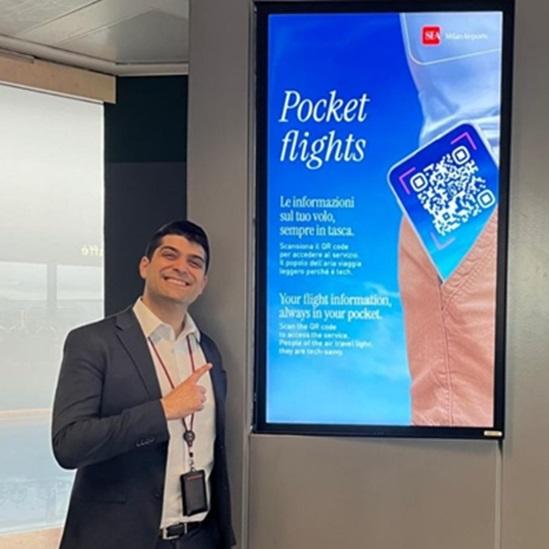
Starting from Friday, May 31st, 2024, the "Pocket Flights" project is live in our airports. This project, which won the internal Call for Innovation where all colleagues were invited to propose their ideas to improve Linate and Malpensa airports, is a reliable and intuitive solution that allows passengers to receive real-time information on their flight status without having to download any app.
By scanning the QR code on the monitors near the flight information displays, passengers can access a webpage with the day's flights and activate push notifications for their selected flight. They can also be directed to their specific flight by scanning their boarding pass. This way, passengers no longer have to wait in front of the monitors and can freely spend their time within the terminal.
The service is available at Linate, Malpensa Terminal 1 and Terminal 2.
INVOLVED DEPARTMENTS: Corporate and Business Communication, Information and Communication Technology, Innovation, Operations, Supply Chain.
An automatic passenger routing system will improve the passenger experience at security checkpoints
On Monday, July 24, 2024 SEA inaugurated in Linate the "Digital Queue" project, one of the proposals that emerged from the 2023 internal Call for Innovation. This system, developed in collaboration with the Dutch start-up Grasp, aims to further enhance the passenger experience and improve operational efficiency at security checkpoints. This is made possible through the application of an artificial intelligence algorithm that analyzes and processes data collected from sensors installed at various points in the security area.
Since its inauguration, passengers, at the end of the queuing snake leading to the security filters, can view on a monitor the direction to follow to reach the most efficient control station.
The core of the "Digital Queue" project is the proprietary algorithm that gathers outputs from sensors installed at various points in the area and uses them to automatically direct passengers to the least crowded and most efficient security control station.
Starting from June 2025, a new functionality has been added: automatic gates have been installed that autonomously adjust the queuing path based on the number of people in the area. In this way, during periods of lower crowding, passengers need to cover a shorter distance to reach the security lines.
The goal is to further reduce the time passengers spend in the security filter area, ensuring an even more quality and stress-free travel experience.
Through the installation of proximity sensors at each devesting station, the system also allows monitoring the status of each line's sub-segments, becoming an additional tool available to the operations team.
INVOLVED DEPARTMENTS: Corporate and Business Communication, Finance and Enterprise Risk management, Health and Safety at Work, Information and Communication Technology, Innovation, Maintenance, Operations, Planning and Control, Supply Chain.
A simple and intuitive platform helps report and find passengers' lost items
Since May 15, 2024, the Foundspot platform has been online, managing the lost and found service at Malpensa. On one hand, passengers can report the loss of a specific item on the portal, entering all the characteristics of the item, such as brand, color, and distinctive marks.
On the other hand, SEA staff will register all items found in the terminal on Foundspot, so that the platform's algorithm can match them with passenger reports and optimize the process of returning lost items to their owners. Of course, the success of the algorithm also depends on the accuracy and detail of the information entered by both passengers and staff.
If their item is found, passengers can choose to either pick it up personally at the lost and found office or have it delivered to their home via one of Foundspot's partner couriers.
The project has multiple advantages:
- Increases the return rate of lost items.
- Reduces the effort of managing lost items by the SEA team.
- Improves and simplifies the experience for travelers in retrieving lost items.
Access to the Foundspot platform can be made directly from the official SEA website: Lost Property
INVOLVED DEPARTMENTS: Digital Channels & Contact Center, Innovation, Operations.
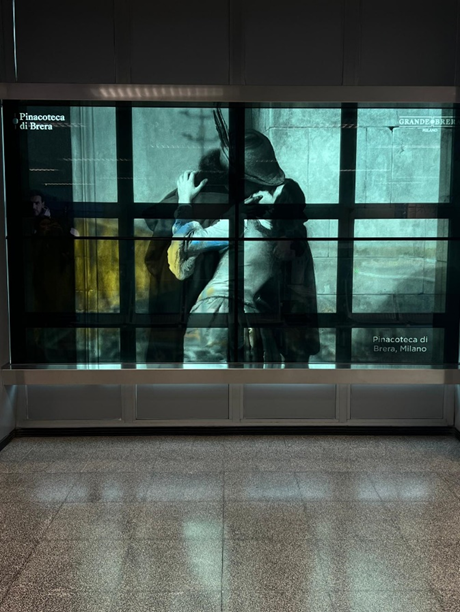
Wideowindow: A New Way of Entertaining Passengers
INVOLVED DEPARTMENTS: Commercial, Corporate and Business Communication, Finance and Enterprise Risk management, Health and Safety at Work, Information and Communication Technology, Infrastructures, Innovation, Maintenance, Operations, Planning and Control, Supply Chain.